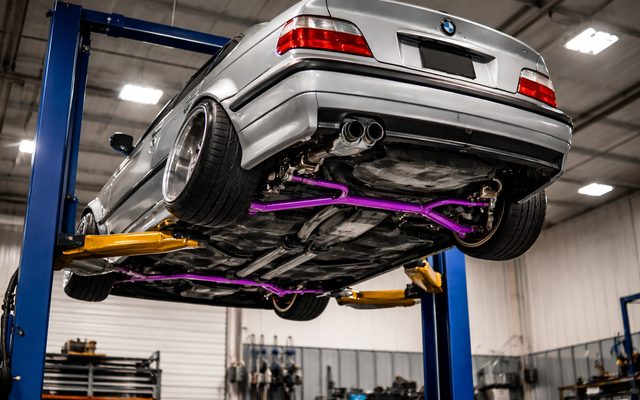
In the high-stakes arena of today's serious sliding, success is far more than exclusively a function of sheer horsepower or behind-the-wheel bravado. Rather, it is now a complex science which demands a painstaking marriage of picking a time-tested chassis, equipping it with the correct drift-spec hardware, and, most importantly, comprehending its real-time performance on the track through advanced suspension tuning applications. This exhaustive handbook functions as your blueprint from the very first concept of a project car all the way to the final telemetry-optimized adjustments that elevate a strong car into a predictable podium finisher. We will delve deep into the precise engineering of car suspension tuning, illustrating how a state-of-the-art suspension tuning tool like precise measurement hardware eradicates approximation and delivers unmatched insight into your car's true behavior.
The cornerstone of any exceptional drift machine is, without question, the base vehicle itself. Certain platforms have attained renowned reputation within the international drifting community due to their built-in balance, robust design, and the vast availability of specialist components available. Selecting the optimal car is the primary and most important choice a enthusiast will make. For instance, the the E36 generation BMW is universally acknowledged as perhaps the the finest all-around drift cars of all time. Its near-perfect 50/50 weight distribution, combined with a driven rear axle configuration and bulletproof inline-six motors, creates a chassis that is at once forgiving for beginners and incredibly effective in the hands of a expert pilot. The successor of this philosophy, the E46 model BMW, builds upon these strengths with a more developed frame, increased track for improved high-speed stability, and still increased steering angle straight from the manufacturer. Another dominant option in the pro circuit is the C6 generation Corvette.
This V8-powered sports car introduces a unique combination of strengths to the drifting world, featuring a lightweight aluminium frame, a backwards-positioned drivetrain component that aids in an perfect balance, and the immense torque of a powerful LS V8 motor. This combination makes it an complete monster on track, capable of initiating and maintaining continuous slides with relatively effortless deployment of throttle. For builders looking for remarkable value, the Nissan Z33 rises above as a excellent choice. It comes from the manufacturer with a robust platform, a effective OEM locking differential, and the responsive V6 engine that delivers sufficient power and torque for practicing and advancing in the activity. Its newer version, the 370Z model, presents more advancements in body strength, steering geometry, and peak motor power, establishing its place as a favorite pick among serious drivers. Further legendary cars that warrant consideration are the nimble unique Mazda FC RX-7, the ubiquitous S13 Silvia/240SX, the torque-rich Ford Mustang SN95, the electronic-equipped E90 3 Series, and the tiny yet unbelievably engaging and forgiving Mazda MX-5. All of these chassis provides a different array of traits, challenges, and potentials, but they all share the fundamental components required to serve as a serious drift car.
However, picking the optimal car is only the first step. To access the complete performance of every of these machines, significant changes to the steering system and suspension systems are absolutely non-negotiable. This is where the realm of performance drift-spec hardware enters sharp focus. The most most game-changing improvement for a dedicated drift car is the installation of a maximum-angle angle modification kit. These advanced kits, for example those manufactured by specialist companies like SLR, are designed to dramatically expand the chassis's maximum turning lock. A OEM street car is severely limited in how far its steering tires can rotate, a safety trade-off for public road driving. In sliding, but, aggressive steering input is continuously needed to manage and sustain a slide. An angle kit replaces the OEM hubs, tie rods, and potentially A-arms with parts that enable the steered wheels to reach steering lock in excess of 70 or even 80 degrees, as opposed to a normal OEM limit of around 40 to 50 degrees.
This immensely expanded capability offers the operator with exponentially more control during a slide, enabling it to be much more straightforward to start a drift, sustain it through a sweeping corner, and transition smoothly from one direction to the opposite. The contrast in controllability is truly revolutionary. Combined with a correctly chosen angle kit is the just as critical upgrade to the car's spring and damper setup. Off-the-shelf or even premium sport dampers are generally not designed for the unique and extreme requirements of competitive oversteer. A purpose-built pair of suspension units is paramount. These engineered coilovers incorporate unique valving and spring stiffness that are tuned for the rapid mass transition that is typical of drifting. When a driver begins a slide, the car's mass is shifted violently to the front of the corner. Optimal competition dampers manage this transfer in a predictable manner, allowing the car to stabilize rapidly and offering the driver clear response through the controls and seat. They furthermore provide precise adjustment of ride height, damping firmness, and corner weighting, which are all fundamental parts of dialing in the car's dynamics to a specific circuit or piloting style. Together, a top-tier drift angle kit and a correctly selected pair of competition suspension units form the absolute hardware foundation upon which all future refinement is based.
Once the core parts is fitted, the subsequent critical step in the development is the precise tuning of the car's alignment. This is the realm of car suspension tuning, a procedure that can seem daunting to the beginner but is, in reality, the key to turning a assembly of capable components into a cohesive and consistent machine. The most critical aspect of tuning for sliding is undoubtedly camber. Camber is the tilt of the tire compared to the vertical line when looked at from the front of the vehicle. If the top of the wheel is tilted towards the car, this is known as camber-in. For drifting, an inward tilt on the front wheels is universally used and is regarded as critical. The logic is intrinsically tied to tire contact.
When a chassis is turning at limit sideways angles, the chassis tilts to the external of the turn. This lean makes the outside front wheel to reduce its optimal contact patch with the asphalt. By adding an inward tilt, the tire is pre-angled to compensate for this lean. As the car tilts into the turn, the tire gains a better contact patch on the road surface, optimizing its grip at the critical point when it is most required for directional command. Usually, front axle angles for a serious drift car fall between approximately -3 degrees to as much as -5 degrees or even beyond, depending on the parameters of the car setup, compound type, and operator style. The back wheels also use inward tilt, but the settings are typically less and more nuanced than the front axle. Too much inward lean at the rear can result in the chassis excessively tail-happy and difficult to predict on throttle input, as it diminishes the effective tire footprint of the driving tires during straight-line power delivery. Thus, rear angles are frequently in the range of -1 degree to -3 degrees, finding a delicate equilibrium between providing adequate side grip to help in starting and holding the slide while simultaneously maintaining usable grip for acceleration the bend. Camber is just one element of the larger suspension geometry picture, which also involves toe, self-centering steering, and suspension-induced steering adjustment.
Toe angle is the orientation of the tires as seen from above. Toe-in means the front edges of the tires are closer together than the trailing edges, while outward toe means the opposite. For oversteer, a slight amount of front negative toe is commonly run to quicken the initial directional feel, making the car feel more agile and eager to begin a oversteer moment. Rear axle toe angle is generally set to neutral or a extremely small amount of positive toe to foster straight-line stability under acceleration. caster angle is the forward or rearward tilt of the kingpin axis when viewed from the side-on of the vehicle. Increased positive caster improves steering feel and high-speed stability, and it additionally adds to inward lean gain during turning, which is highly useful. Tuning these settings is a complex dance where a adjustment to one value can and often will impact the others. The old-school process for dialing in a vehicle's alignment for drifting has historically been a tedious endeavor of guesswork and adjustment. A driver or team would introduce a modification based on experience, drive the car drift tuning app on track, rely on the pilot's subjective sensation and impressions, and then apply another tweak. This process would continue time after time until the chassis felt "acceptable" or the allotted practice session ended. This system is not only exceptionally wasteful in terms of time and costs, but it is furthermore deeply flawed.
Driver feel is a infamously subjective metric, affected by numerous variables such as fatigue, evolving track surfaces, temperature, and simply the mindset of the operator on that particular session. What feels "oversteery" on one run might feel "tight" on the next run, resulting in confusing feedback and frustrating adjustments. This age-old limitation in chassis setup is precisely where state-of-the-art engineering tools has made its mark to transform the methodology.
The development and application of advanced suspension tuning applications has ushered in a completely new era for tuning and perfecting competitive drift cars. This new generation of tools, represented by innovative products like data acquisition tools, work by physically recording the real-time dynamic behavior of the chassis as it is being driven on the circuit. Unlike relying on driver impression, these devices gather measurable metrics on essential factors such as suspension travel, individual tire rotation, acceleration forces, lock position, and accelerator and brake pedal application. This raw information flow is then processed by sophisticated applications that can graph and analyze the metrics in a clear way. For the first time ever, engineers and teams can observe specifically what the chassis is performing at any given point of a lap. This capability changes the complete alignment optimization workflow. Think about the aforementioned task of dialing in the front negative camber for a particular car. Rather than applying a adjustment from -3 degrees to -3.5 degrees and then testing many passes to try and "sense" a improvement, a vehicle dynamics tool can deliver immediate and definitive information. The application can indicate in a chart how the tire's contact patch is behaving during the critical phases suspension engineering of a drift: the initial flick, holding the angle, and transition. It can demonstrate if the existing angle is enabling the loaded tire to keep ideal grip or if the compound is over-stressed on its outside shoulder.
The tool can subsequently provide data-driven advice for adjustment. Perhaps the data reveals that the tire is even overloading its sidewall at -3.5 degrees of camber, implying that an increase to inward lean, say -4 degrees, might be advantageous. On the other hand, the data might show that the tire is not reaching temperature or that the inner shoulder is degrading excessively, which drift suspension tuning guide could indicate that there is excessive negative camber and a slight lessening back to -3.2 degrees would be more efficient. This degree of accuracy and practical intelligence was literally unimaginable in the days of exclusively mechanical adjustment.
The effect of using a comprehensive drift telemetry system goes far beyond just dialing in alignment. It serves as an priceless coilover setup tips that is customized to your specific car. When setting the shock absorber clickers on your suspension, rather than relying on imprecise tips or mimicking another car's settings, you can employ the software to observe how the vehicle is performing in relation to your changes. The tool can display the suspension travel data over a lap, showing if the dampers are controlling the chassis motion effectively or if they are permitting the vehicle to bounce excessively after a transition. It can help in identifying issues like excessive compression or excessive extension, permitting you to make data-backed decisions to preload settings, damping settings, or ground clearance. This approach translates equally to the intricate art of suspension geometry optimization. In addition to camber, the system can offer data into how adjustments to toe and caster are affecting the car's handling during specific phases of a slide. For example, it can allow you to find the optimal amount of front axle negative toe for your particular angle kit configuration and piloting style by measuring the quickness of initial response and the predictability of the car at full countersteer. This transforms the system an extremely useful drift suspension tuning guide that is dynamically calibrated by the real-world dynamics of your specific car on the tarmac. It elevates the entire process from a subjective skill into a scientific optimization exercise.
Furthermore, the utility of a platform like data acquisition is in no way limited to professional teams with large budgets. For the amateur driver, it functions as an incredible educational tool. It practically offers the builder with the knowledge of a expert dynamics engineer without requiring the associated overhead. It speeds up the tuning process by providing clear directions to challenges that would normally take years of experimentation to solve. A builder can see how their specific vehicle responds to different settings, gaining a more profound knowledge of suspension theory in the journey. It furthermore makes accessible professional chassis dynamics concepts, allowing anyone with the drive to perfect their machine to accomplish it in a efficient and productive fashion. This is especially important in a sport like drifting, where engineering know-how has in the past been a tightly held commodity among professional teams. In the modern era, that power can be in the hands of any dedicated builder.
In the final analysis, the path to constructing and tuning the perfect competitive drift machine is a comprehensive mission that smoothly combines proven hardware principles with revolutionary digital tools. It begins with the informed choice of a capable platform, followed by the integration of non-negotiable drift-spec components like drift-spec angle modification systems and correctly valved performance adjustable dampers. The journey then advances into the precision phase of alignment optimization, where parameters like camber, toe setting, and caster are precisely set to match the chassis's new capabilities and the pilot's personal style. Ultimately, and what truly distinguishes the contemporary process from the old ways, is the use of a powerful vehicle dynamics tool. This platform eliminates the uncertainty and inefficiency of solely subjective adjustment by providing quantifiable, live information on how the chassis is actually performing. It acts as an unparalleled engineering partner, a definitive alignment optimization handbook, and a comprehensive chassis development system. As a complete package, this complete methodology leads to that each and every element of the drift car—from the choice of the chassis to the most minute click on the suspension—is refined for maximum competitiveness on the circuit. It embodies the full progression of the sport of sliding, merging physical pilot talent with precise chassis dynamics to build the ultimate effective machines attainable.